Subscribe to "PriorThoughts"

Subscribe

* indicates required

Friday, November 17, 2017

October 2017 | Northern Spain

We recently returned from an 18-day trip to northern Spain, completing our tour of this wonderful country. In May 2011 we travelled the south, and in February 2012; Madrid and central regions. Much earlier, in the Nineties, we had visited Barcelona.

Sárdon de Duero
October 09 - 11:
It was into Madrid airport to start this adventure, renting a car there and driving northwest 200 kilometers to Sárdon de Duero in Castilla y Leon, and the Abadia Retuerta L’Domaine; staying three nights. This hotel is a former monastery amidst acres of vines – its wines are very well regarded. We were in room 206, very nice. The staff gave us a tour and that evening we had an 11-course tasting menu with wine pairing in their gourmet restaurant, Refectorio.
Abadia Retuerta L'Domaine

We awoke to a beautiful day, sunny with highs of 80°F. After a nice breakfast we were off to Burgos, 160 kilometers to the northeast. It is an old city, founded in 884, and played an important political, military and commercial role throughout the centuries. Our reason for visiting was the Burgos Cathedral, founded in 1221, a Gothic masterpiece. The magnificent star-ribbed central dome rises on four huge pillars. Built on a sloping site, there is a wonderful staircase linking the nave to the upper street level. I must compliment the creator of the audio guide for the visit – excellent.
Burgos Cathedral
Star-Ribbed Central Dome


The Staircase

Arriving back to the hotel, the weather was so delightful we went to the outdoor pool for some late day sun; I was brave (or foolish) enough to take a swim in the frigid water.
Dinner was at the hotel’s casual restaurant, Vinoteca; very good salad and lamb with rice. The vineyard’s 2010 Pago Negralada Tempranillo the perfect accompaniment.

Another beautiful day, we were off to Valladolid, just 60-kilometers west of the hotel. Although now a modern sprawling city, the old town is packed with history. Fernando and Isabel married here in 1469, laying foundations for the modern Spanish state, and beginning the drive to push the Moors from the country; Granada finally fell in 1492.
We parked by the rail station and walked to Plaza Mayor visiting the 15th C university with its impressive Baroque façade, the three churches of Iglesia de Santa Maria la Antigua, Iglesia de Nuestra Senora de las Angustias and Iglesia de San Pablo; and finally, the cathedral. 
Valladolid University

The Cathedral Metropolitana is an unfinished work, started in 1580. It gradually lost momentum but the redeeming feature is the flamboyance of Juan de Juni’s altarpiece. The Museo Diocesano inside contains some beautiful religious art and sculpture.
Lunch was tapas at La Cantina on Plaza Mayor before our drive back to the hotel. We had a little more time at the pool; weather still unseasonably warm. It was dinner again at Vinoteca and then to bed.

Leon
October 12 -13:
Before leaving the Abadia Retuerta L’Domaine, we walked the vineyard along the Duero River; the weather was still beautiful – there is something spiritual connecting the land with the eventual elixir in the bottle. Our next stop, Leon, was about a two-hour, 200-kilometer drive northwest. We arrived to the Parador de Leon on Plaza San Marcos; a 16th C Renaissance marvel, one of the best examples in Spain, along with its well-preserved Cloister of San Marco.
Unfortunately, the rooms and interior public spaces were sad. The spartan décor would be a familiar sight to the monks; only the poorly done modernizations would seem odd. Judith and I were both sure many centuries of clerics had slept in our bed, the indents of their bodies visible in the saggy mattress. In a word, awful accommodations; ditto for the food. By the way, the monks didn’t have Internet access, neither did we.
We were quickly out to see the city, walking up the Gran Via de San Marcos to the old town, then on Calle Ancha to the Leon Cathedral. Begun in mid-13th C, it was inspired by the French techniques of vaulting and buttressing in their Gothic cathedrals in Paris and Chartres. The tall nave is slender and long, showcasing the great glory of the stained glass, 182 windows in all, spanning the 13th to 20th centuries. The adjoining museum off the cloister contains a wonderful Pedro de Campaña panel. 
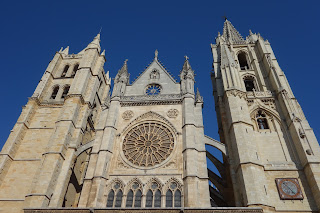
Leon Cathedral


Main Altar

We had a cava near Plaza Regla, walked back to the parador and visited the adjacent Museo de Leon. After a blah dinner of baby lamb, it was off to bed.

Up to a very proletarian breakfast, we were off on a very nice day to see the rest of the city. Our first stop was in the northeast of the old city, to the best preserved of the ancient Roman walls and the Colegiata de San Isidoro, actually a part of the walls. Travelling south along Calle Ruiz de Salazar we visited two well preserved palaces: Casa de los Guzmanes with its elegantly arcaded Renaissance patio, and Antoni Gaudi’s unusually restrained Casa de Botines. Still further south we saw three plazas: Plaza del Grano, Plaza San Martin and Plaza Mayor. Lunch was on Calle Ancha at Via Principalis.
Casa de los Guzmanes

We dragged ourselves back to the hotel and had drinks on the terrace, cleaned up, had another bland meal and were off to bed.

Santiago de Compostela
October 14 – 15:
We were up early and off to Santiago de Compostela, 3 ½ hours and 320-kilometers, again northwest. Leaving Castilla y Leon behind, we travelled to the Galicia region, the remote northwestern corner of the Iberian Peninsula. The discovery in the 9th century of the supposed remains of St. James the Apostle confirmed Santiago de Compostela as Medieval Europe’s most important religious shrine after St. Peter’s. For over some 1,000 years pilgrims have followed the route over the Pyrenees and along the north coast of Spain to this holy destination.
Our home for the next two nights was the modern NH Collections Hotel, just a bit outside the old city. Unpacking quickly, we were off on a 20-minute walk to Santiago Cathedral, travelling up Rúa de San Francisco like so many pilgrims before us. Unfortunately, a large portion of the majestic west façade of the church was shrouded by scaffolding, hiding most of the twin Baroque towers that reach high over Praza do Obradorio. The present building dates from the 11th – 13th centuries.  Entering, there was more ongoing restoration obscuring the ornate high altar and the iconic botafumerio, the giant silver censer that hangs above it. We left a bit unimpressed; perhaps our expectations were too high.
Botafumerio (Censer)

We walked the balance of the city, passing through Plaza de Cervantes and stopping for a pleasant lunch at Café de Altamira on Rúa das Ameas, east of the cathedral. We were back to the hotel by early evening and had a light dinner at the bar of some charcuterie and a bottle of local white.

The morning’s weather did not look promising as we left for Costa da Morte, the wild and remote “coast of death” stretching from Fisterra in the south to Malpica in the north. The coast is dotted with isolated fishing villages, tucked into the majestic headland.
We were heading west on AC-441, about 1 ½ hours, to Cabo Fisterra (“where the land ends”). The terrain drops into the sea, scattered with rocky outcroppings, menacing shipping over the millennia. The lighthouse stands sentry to this place where the pilgrimages final ended; many trekkers burning their shoes to mark the completion of their journey.
Cabo Fisterra Lighthouse


Pilgrimage End

Afterward, we drove along the coast and up into the hills to O’Fragón Restaurante and had a wonderful lunch: blue lobster to share, then a tasty grilled seabass. It was then another drive on to Carmariñas, seeing many of the iconic hórreos, quaint stone grain stores on raised stilts; and Rio de Porto Rias. A “rias” is a long tidal estuary, and found all along the coastline of Galicia. 
Judith posing in front of a  "Hórreos"

We got back to the hotel around 6:00 pm; dinner was at the hotel and so-so.

Lluces
October 16 – 20:
We left Santiago de Compostela early on another overcast morning, driving east-northeast 320 kilometers, a 3 ½ hours’ drive. The route took us through the western edge of the Galician Massif and into Asturias and Cantabrian Mountains. The effects of Ophelia, the easternmost Atlantic hurricane on record, made for a windy and sometimes rainy trip. This was added to by smoke from forest fires in southern Galicia and northern Portugal. Sadly, all were started by arsonists. So the air was thick with a smoky fog, but it added to the atmosphere as our route passed through pristine forests, pastureland and deep gorges. At times we were just meters from the ocean. The landscape was dotted with wind turbines, the country is the fifth largest producer of wind energy, contributing 19% of its total domestic electricity demand.
Hotel Palacio de Luces

We arrived to Hotel Palacio de Luces at about 2:30 pm, a very bucolic Relais & Chatueax property just a few kilometers from the Atlantic. After a quick lunch of croquetas, we had a swim in the indoor pool. Dinner was terrible, a traditionally served chicken: a giant chicken leg (it could have been from a small pig) served in a thick muddy brown sauce. Oh well, it was off to bed.

We woke to an overcast morning with an acrid smell of smoke in the air. After breakfast we drove east on the coast road, AS-257, to Lastres, and then the N632 to Ribadesalla. This is an upscale town with a wonderful seafront on a broad estuary of the Sella River. There is a striking white church perched upon a promontory looking out to the Atlantic. We walked the jetty and were buffeted by high winds.
Ribadesalla's Church


Brave Surfers

Back to the car, we winded our way further east along the coast on AS-263 to Llanes where we had a nice lunch at El Cuera – very good croquetas, and a wonderfully rich white bean and pork cassoulet, locally called Fabada. Taking the A8 back to the hotel, the haunting Picos de Europa looming high to our left, we stopped at a car wash to clean the built-up ash on the car.
I took another swim; dinner was not very good which meant more leftovers for the white house cat who seemed very happy (and fat).

More rain to start another day. After getting totally twisted around in the wrong direction, we finally made our way up very winding roads, looking down into deep gorges, to Santuario de Covadonga nestled in the Parque de los Picos de Europa. These beautiful mountains purportedly got their name, “Peaks of Europe,” from returning sailors for whom this was often the first sight of their homeland. Built between 1886 and 1901, the church here is a Neo-Romanesque basilica and stands at the supposed site of Pelayo the Warrior’s victory, in 722, over the much larger and better equipped Moorish army. This is of course fiction; this battle most likely took place in Cantabria – an early example of “fake news.”
Santuario de Covadonga
We headed back to the coast and to Comillas, known for its many buildings designed by Catalan Modernista architects, including the grand Palacio Sobrellano built in 1881. Overshadowing all is Capricho de Gaudí, a small colorist palace designed by the then young Antoni Gaudí. In town we had lunch at the work-a-day Samovy Restaurante – grilled ham and cheese; Judith finished with the regional chocolate con churros.
Capricho de Gaudi

Our final vsit was to the beautiful fishing port of San Vincente de la Barquera, its low-slung stone Maza Bridge gracefully crossing the broad estuary. We arrived back to Palacio de Luces about 6:30 pm, a 370 kilometers jaunt. Breaks in the rain blessed us at each of our stops.
We had light bar fare this evening; unfortunately, also two bottles of 2015 Belondrade y Lurton Verdejo!

We woke to another overcast day, travelling west along Coste Verde, or Green Coast, which is a beautiful succession of attractive coves and dramatic cliffs, punctuated by deep estuaries and pretty fishing villages. Our first stop was Luarca, a neat little harbor packed with boats, and a cemetery perched on a promontory. It was difficult to get to but worth the effort; it is consistently ranked in the world’s “top ten” most picturesque graveyards.


Luarca Cemetery


Luarca Cemetery

It was then on to Cudillero, another tiny port positioned at the base of a deep gorge. We parked and walked around looking for a lunch spot, but we found nothing appealing. 


Cudillero

Thus, our midday meal was a highway rest stop; we also had a self-service car wash to clean more fire ash off the car and fueled up. Before returning to the hotel, we checked out the nearby lighthouse in Lluces (faro in Spanish). I got another swim in; then we were down to dinner. Nothing special.

Our final day here was reserved for a visit to Oviedo, about 60-kilometers west and inland from our location. We parked near the beautiful, centrally located park of Campo San Francisco before walking to the cathedral. It is in Flamboyant Gothic style, with a very high tower and asymmetrical façade. There are many wonderful works of art; a 16th century reredos, the supreme treasure of Cámara Santa chapel from the 9th C, and many other gold and silver objects of beauty.
The city was made more famous by Woody Alan and his 2008 movie “Vicki, Cristina, Barcelona.” We bumped into a life sized brass statute of him and Judith took a cheeky photo of us together. 
Woody & Me


Leaving the city early afternoon, we made our way to Mount Naranco and its two magnificent Pre-Romanesque churches. Santa Maria del Naranco is the more impressive; its large barrel-vaulted hall on its main floor opens to two arcaded galleries on each end.
Santa Maria del Naranco


Barrel Vaulted Hall

We drove back and had a very late lunch in Ribadesella, arriving back to Hotel Palacio de Luces after six. Another swim; then we had another uninspired dinner in the hotel.

San Sebastián
October 21 – 25:
We were up for a late breakfast and left Lluces for San Sebastián, 4 hours’ drive east into the Basque region, arriving at Hotel Maria Cristina about 3:00 pm. Our first suite was not to our liking, the staff switched us to a terrace suite, #503, which was very nice. After unpacking, we took a short walk to the Zurriola Bridge and watched the tidal waves crashing into the estuary of the Urumea River that cuts through the city on its way to the Bay of Biscay. It was room service for dinner, accompanied by a strong rainstorm. We were quickly asleep.
Zurriola Bridge - Hotel Maria Cristina in background

Up to cooler and more unsettled weather, we were out to explore the old town. It is a maze of small streets tucked behind the headland of Mount Urgull. Our first stop was to the 16th C Church of St. Vicente, then out to the promenade that circles the base of Urgull, eventually leading to the aquarium and the port. Lunch was at Borda Beri on Fermin Calbton Kalea; we had a local small plate specialty called pintxos. These bite sized portions are laid out on the bar, you are given a plate and make your selection; then pay the bartender, perhaps also asking for a vino blanco (yes, of course I did).
St. Vicente Altar
Promenade - Rough Sea
A Selection of "Pintxos"

Afterward, we dodged the raindrops to visit Museo de San Telmo. The large museum is housed in a 16th C monastery. Its chapel contains 11 large murals by Catalan artist Maria Sert, depicting Basque legends and culture. There was a large display of local decorative arts and an extensive collection of paintings by Basque artists. A standout for me was Antonio Ortiz Echagüe’s “Dos Mujeres del Taliflet,” or “Two Moroccan Women.” Overall, an excellent few hours.
Murals of Maria Sert


"Dos Mujeres del Taliflet"

We walked back through Place de Constitucion, with its rows of numbered yellow balconies. In the past this square was used for bullfighting and these terraces were rented out to patrons by the municipality.
Place de Constitucion

We were late reserving at the many Michelin-starred eateries, but the concierge booked a nice spot for dinner in the hills overlooking Zurriola Beach, “Zelai Txiki,” meaning small fields in Basque. We had very good scallops and turbot. After a nightcap at the hotel bar, it was off to sleep.

We finally awoke to the sun. After breakfast we took a long walk west on the promenade of Kontxa beach to the Wind Comb sculptures of Edward Chillida, which are mounted in the rocks at the shoreline. Then it was back to the old town, visiting the town hall and later, lunch at another pintxos spot, Restaurante Bartolo – again very good. We finally had our bearings in the winding narrow streets.
Kontxa Beach
Chillida's "Wind Combs"
More Pintxos

We took the afternoon “off,” and had another good dinner in the old town at Casa Urola; piquillos as a starter, followed by a very nice sole.

Judith and I were starting to run out of steam; we had spent two weeks in non-stop tourist mode. The day was again sunny, so we took a leisurely walk east along the Zurriola beach to its end to see the Dove of Peace sculpture by Nestor Basterretxea. Lunch was at IBAI in the Zentro section, on the fashionable Calle de Getaria. IBIA is known as a chef’s restaurant, the preferred place for many of the city’s top culinary stars. It was a simple establishment, quite small, and in the basement of a nondescript bar. Our beef main course was superb; and it was fun to watch the passion for food and wine in the other professional patrons. Lots of smelling, smiling, laughing, oohs and aahs!
More rest late afternoon; dinner was simple and at the hotel’s bar.
IBIA

We received the gift of another nice day. In the morning we walked some more neighborhoods, skirting the Urumea River up to the beautiful Maria Cristina Bridge. It was then back to our car; we were off to Bilbao and the Guggenheim. So much has been written about this Frank Gehry architectural marvel, clad in titanium. It is impressive and strangely organic, in spite of its metallic skin. But the building is the attraction, nothing inside really moved me. I came away with a sense that there really wasn’t much art, only very sterile “installations.”
Bilbao's Guggenheim
Interior Shot

We walked a bit more after our return to San Sebastián; dinner was uninspired at the hotel’s Café Saigon.

Back to London
October 26:
We were up early, had a quick breakfast and were off to Bilbao’s airport. After dropping off our car at Hertz (we had driven a total of 3,337 kilometers), we had a short wait until our flight departed. It was a smooth trip; Masood had us back to our flat by 3:00 pm.

Looking back, we had seen lots of beautiful architecture from the 9th to the 20th centuries. Still, for me, the real star was the landscapes travelling out of Castilla y Leon and then into the very picturesque northern countryside of Galicia, Asturias and Cantabria, and the Basque region. I recommend it highly.


Thursday, September 21, 2017

Fortnight in South of France

We travelled from Budapest via Vienna’s airport for our 22nd September in South of France and the always wonderful La Reserve in Beaulieu-sur-Mer. We arrived late afternoon, unpacked and said our hellos to the longtime staff. I thought a Bellini would also be in order to kick things off. Dinner was on the terrace with a waxing crescent moon shimmering off the calm waters of the bay. One cannot get tired of this view.
Moonlight Alfresco Dinning - La Reserve

We were here two weeks and continued our morning tradition of our walk along Promenade Rouvier to St. Jean Cap Ferrat and La Civette Café for cappuccinos and croissants. It’s a peaceful one-hour walk with lovely sea views along the whole route.
View from Promenade Rouvier

What followed most days was swimming and reading poolside, a pleasant lunch on the point and perhaps a Bellini before heading back to the room around five. About half our evenings were at La Reserve’s restaurant.
Our "Film Noir" shot - circa 1940s
(Photo credit to John)

The scene at "African Queen"

But we also were out and about. A dinner or two at the African Queen in the port, one at La Mére Germaine in Villefranche. On Thursday, the 14th, we took the train to Cannes to visit the boat show, lunching afterward at the Majestic Hotel’s Le Fouquet’s – very nice. The beautiful German made Hanse sailing yachts were very alluring, especially after our sailing trip in Croatia in August.
Philip and John were staying in Monte Carlo and we saw them for a very good lunch at La Reserve and Rossie and Adrian at the African Queen for dinner twice; and also at La Reserve for lunch. And we also had a wonderful dinner and evening with Maryléne and Gilbert at their home in Roquebrune Cap-Martin; along with Philip and John.

The "Gang" at Maryléne & Gilbert's

Other things to note. Guillaume, the restaurant’s maître d had a pretty baby girl, Lilou; STING was at the hotel for a few days, apparently doing a gig for some rich oligarch on Cap Ferrat, and also a very young singer, “Cris Cab,” (actual name Christian Cabrerizo) who jammed a bit with the hotel’s pianist one late evening while Judith finished her Amaretto, and I, a wonderful 1949 calvados. He seemed happy to talk to us old folks. Check out his “Liar-Liar” video, pretty hot:
David Livingstone, La Reserve’s pianist for 29 tears is retiring; we wished him well – his music is heavenly.

The weather turned cool the last few days, but otherwise cooperated. On Tuesday, the 19th, we left for Vienna, returning to a rainy Budapest by car. Our 22nd September in Beaulieu was over; we look forward to next year!

Thursday, August 31, 2017

Sailing the Croatian Coast - August 2017

I last sailed in earnest as a teenager in the Caribbean, and some lake sailing in New York and Vermont a bit later on. It was always an enjoyable pastime; a peaceful escape from a fixed, land based life into something more fluid, more open. I always had a yearning to return to it, and in retirement recently indulged my desires.

MARINA CAŠTELA
So, we left for our Croatian sailing adventure from Budapest on August 18, stopping one night in Zagreb before arriving in Marina Kaštela, just north of Split, on Saturday the 19th.
Our boat for the week was “TINA,” a 53-foot Jeanneau sloop built in 2008. Our skipper, Tilen, was young but experienced, and our hostess, Cornelia, also young and lovely. After a quick orientation, Cornelia was off to purchase our initial provisions.
The yacht itself was a bit of a disappointment, slightly worn and configured for a larger party; four small cabins plus a small crew cabin; toilets un-modernized. With just Judith and me, we would have been better off with a master cabin configuration and a newer boat. Next time we will be more discerning, but I booked late and in the high season.
Our Yacht "TINA"

The plan was to leave early evening for the close by island of Solta; but there was a possibility of high winds overnight, so we opted to stay in port overnight rather than on anchor. We had dinner in the port restaurant and afterward retired to the forward port cabin. Rather closed in, Judith left after a few hours and took up position on the salon’s couch – a less confined space. With a master cabin, this would not have been a problem.


VIS ISLAND
We had an early start on Sunday the 20th, heading south through the cut between Solta and Brač Islands and then into open waters. Vis is about 27 nautical miles (say 50 kilometers) away. Shortly out of port, Cornelia served a wonderful breakfast (the first of many more, in fact). The winds were light, but the sea was a field of choppy conical shaped waves with no real direction. Last night’s combination of Jugo and Bura winds set up the conditions, which made for both heave and sway motions for the boat – we needed to be careful moving about.
We entered the northern horseshoe shaped port of Vis Town around four in the afternoon; a long motoring day, and tied up to the jetty wall, already lined with yachts. There was time for a quick walk around town, and out to Lady of Spilice Church on the point. It had a smorgasbord of styles, dating to the early 16th century.
Serendipity had brought friends Tim and Ana Maria also to Vis; they were staying in Komiža on the south coast. We all went to a country restaurant in the hilltown of Podšpilje, the Pojor Restoran. We split lamb and octopus “peka,” a savory, fire roasted, slow cooked dish. Peka loosely means “under the bell,” actually a large cast iron cover over a large fireproof dish, holding in all those delicious flavors. The lamb with roasted potato was especially good.
More wind was predicted overnight, and we weren’t disappointed. The northerly gusts pushed directly into the harbor; the boats (and us) were pounded most of the night; wind whistling through the rigging, waves crashing into the jetty. Judith and I had a very restless sleep.


Entering Vis


Vis Town Riva

Lady of Spilice Church


Up the following morning, the weather had improved but the seas were still heavy. Further west on the riva a few yachts suffered some damage.  Our plan was to move on to Vela Luka on the western tip of Korčula Island. Our skipper Tilen advised that we instead stay in port for the day, so we made plans to explore the rest of Vis. There is much history and mystery here, first settled by the Illyrians, then the Greeks and Romans. Finally, during World War II, Tito established his headquarters in a cave here on Hum Mountain.


My "Wheels"

I rented an old green “chopped” convertible VW (circa 1970) from a local shop, and we headed out to the port’s headland and visited the castle fortress of King George, built in the early 1800s. Then it was off on route 117 to the smaller town of Komiža. It had a certain charm, perhaps less cosmopolitan than Vis, also with a very pretty and bustling seafront. We surprisingly bumped into Tim and Ana Maria again, and had an impromptu lunch with them at Fabrika on the riva. Afterward we were back in our Bettle continuing on 117 to Hum Mountain, 587 meters elevation, visiting a small stone church, St. Duh, and taking in the wonderful panorama. We continued circling the island until we returned back to Vis Town and gave back our very elegant transportation.


Komiža

Komiža Panorama


St. Duh


Dinner for us was waterside at Kolderaj Restoran. Later, Tim and Ana Maria stopped by TINA for some wine, and a wonderful cheese plate and other savories prepared by Cornelia. Sleep came easily, but by early morning the northerly wind had picked up once again and we were jostled about.
Ana Maria, Judith, Tim and me


KORČULA
We left port after a nice breakfast; the wind had calmed a bit. It was a long voyage east, about 40 nautical miles, but only a few hours under sail since we were becalmed by midday. Still the views were fantastic, as we moved between the island’s 47 kilometers of coast to starboard, and the rugged hills of the Pelješac Peninsula to port. We arrived at namesake Korčula Town and the ACI Marina late afternoon.


Approaching Korčula Town


Korčula Town from above

The old town is a picture postcard, with its sturdy rock walls rising from the sea and stone pines providing shade along the busy promenade. We had already booked Lešic Dimitri’s Relais & Chateaux property for dinner, and I decided to also treat ourselves to a night onshore at its boutique hotel. It has only six rooms, we were in the eclectic Arabian Suite on the top floor – paradise compared to the spartan quarters aboard TINA. Tilen and Cornelia joined us for a very peaceful and pleasant alfresco dinner and then we were off to a quiet sleep.


Arabian Suite at Lešic Dimitri’s Relais & Chateaux 


MLJET ISLAND
After a nice breakfast at the hotel, we rejoined our yacht for our trip to Mjlet. The journey under motor because of very light wind was about 25 nautical miles to the east southeast; we entered a very pristine bay on the northwest of the island – the town of Polače, within the Mljet National Park. We tied up at the Calypso Restaurant, where dockage is included with dinner – how convenient!


Entering Polače on Mljet Island

Benedictine Monastery

Veilko Jezero's waters

We had the balance of the afternoon free, so we visited Mljet’s internal salt water lake, Veilko Jezero; and its Sveta Marja, an island in that lake. There is a 12th century Benedictine monastery with a pleasant cloister located here – the surrounding waters are a very clear aqua marine with several unique marine species.
Back to the boat, we arrived just as an older couple was attempting to dock beside us, it seemed rather a controlled crash. Tilen adeptly came to their rescue. They obviously had been sailing for many years, but had never really developed the coordination needed for any chance of success – “an accident waiting to happen” so to speak.
Dinner, of course, was at Calypso, and pretty good. We were soon off to a quiet sleep.

PAKLINSKI OTOCI
Now Thursday, it was time to start our journey back to Split, heading west northwest retracing our route past Korčula and along Hvar Island, about a seven-hour trip. 


Calm Seas

Wonderful Views

Our destination was the Paklinski Otoci, or Devil’s Islands, a 16-island chain just south of Hvar Town. We docked at the ACI Marina on St. Klement Island, the chain’s largest, in the north facing port of Palminžana. It is an excellent, well equipped facility, capable of handling over two hundred vessels. Tilen’s connections allowed us a very favorable berth.

Palminžana on St. Klement Island

With evening approaching, Judith and I were able to sneak in a swim in a nearby cove on the south side of the island, a mere 300 meters walk from the marina. Dinner was also overlooking this same cove, at Laganini Restoran; we had grilled dentex, a local white fish, both firm and tasty. The four of us wandered back to the yacht and were soon with our dreams.

BACK HOME
Friday morning, we made the final voyage back to Marina Kaštela and bid our two young sailors farewell. 
Tilen and Cornelia with one of her wonderful lunches
If you want to reach Tilen about a cruise, email him at: tilen@theyachtbreak.com

Or visit the website: theyachtbreak.com

We left early in order to avoid the crush of Saturday traffic heading away from the coast. After an overnight in Zagreb, we arrived back to Budapest Saturday afternoon.

For me, it was a wonderful reunion with the sea. Judith too enjoyed her time and we plan on another trip on a more comfortable boat sometime in 2018.


Friday, May 26, 2017

Mallorca: May 2017

We left for Mallorca on May 13th, staying for a bit over a week. It was a good flight from Heathrow to Palma, and after picking up our Mercedes from Europcar it was about a 30-minute drive west to our hotel in Port Adriano, the Pure Salt. We were last to the island in August 2015; and like last time, met our friends Annie and Joël.
Port Adriano

The hotel has 91 rooms and our room had lovely views to the sea and Port Adriano. The port was planned by the prolific designer Philippe Starck and houses upscale shops, restaurants and is packed full with super yachts.
We met our friends for dinner on our first night at the hotel’s restaurant, mediocre at best.

What followed was a week of wonderful sun, relaxation and a lot of eating. Annie and Joël are foodies extraordinaire; and our reservations were excellently planned. The best of these was in Palma at Di Tokio a Lima housed in the boutique hotel Can Alomar. 

Di Tokio a Lima Terrace

The tasting menu at one-stared Michelin Marc Fosh was unfortunately disappointing for all of us – still the local rosé wine was good: “Project 2015.”
Marc Fosh - Palma

Another evening had us to the interior of the island; we revisited Zaranda at Castel Son Claret, also one-Michelin starred. The 37-year old chef, Fernando Pérez Arellano created a set menu of eight courses – very over the top. Still, the dishes and presentations provided us with a bit of humor, including a last puzzle course of “a hand of the route of spices.” We had a quick tour of the kitchen after our meal.
Castel Son Claret
"Hand of the Route of Spices" - two pieces already missing!

More casual fair was had al fresco with paella specialties at Palma’s Caballito de Mar, and a fun evening at Claxon, a local, hip and youngish spot on 31 Diciembre, 9. Our last meal was in the port, at Ristorante Giuseppe.

View from Pool at Hotel Pure Salt

Weather was great throughout; the fresh water pool, although cold, was excellent for swimming. We got our walks in, down to the port most mornings; breakfasts were good, and there was even time for some shopping. On our last day Annie and Joël left before us; we had an extra few hours before leaving for the airport. We arrived a bit late back to London, but still in time to get to Waitrose for some milk for our morning coffee – back to real life.

Tuesday, April 18, 2017

Veneto & Friuli: April 2017

From our base in Budapest, we took a one week trip, April 2 - 9, to the Veneto and Friuli region of Italy. The area has always been shrouded by the touristic shadow of Venice, but there is much beauty, history and culture here. The Romans established important outposts to protect the trade routes of the Serenissima between Venice and Genoa; and the Brenner Pass, servicing traffic over the Alps and northern Europe. Roman ruins dot the cityscapes.
This strategic importance continued under the benign rule of the Venetians; wealth from agriculture, commerce and the spoils of war paid for the continual beautification of the region’s cities. The palazzi and villas of Veneto’s greatest architect, Andrea Palladio, are telling symbols  of the leisured existence of the area’s aristocrats.

            TRIESTE
It is a six hour, 550-kilometer drive from Budapest; we arrived a bit after five o’clock to the Savoia Excelsior Palace on the Riva Caduti Per facing the Bay of Trieste. The line is “that if you have nothing good to say, then just say nothing.” Thus, there will be no description of the hotel, our room or its restaurant. We were here for two nights.
After unpacking, we had a quick outing before dinner seeing the expansive Piazza dell’Unita d’Italia with its imposing city hall, and the somewhat tired Canal Grande. Looking at a map, it is clear that Trieste was an important spot coveted over the millennia by many a despot. The Austrian-Hungarian Empire controlled the area for most of the 19th century, home base for its navy. The spot’s natural inclination was to look east. The history is captivating, but I will leave it be. But the final outcome of Trieste was not really settled until the 1975 Treaty of Osimo and the 1992 affirmation of it by the newly minted nation of Slovenia.

Castello del Miramare
There were many lovely sites, a well preserved Roman theatre, the hilltop fortress and church of San Guisto, the Greek Orthodox St. Nicolo among many others. 

Still, the standout attraction was eight kilometers northwest of the city center, the Castello del Miramare. It was built between 1856 and 1860 by architect Carl Junker, along with exquisite gardens spanning 54 acres, for Hapsberg Archduke Maximilian I. Its white exterior walls stretch right to the beautiful blue water of the Adriatic.

VICENZA
We were up early to a warm day, checked out and were off heading west to Vicenza, about a 2 ½ hour, 230-kilometer drive. Our actual destination was Villa Michelangelo in Arcugnano, just south of Vicenza off the A4. The suite was a disappointment; a vision from a bygone era, but not a good one. After unpacking, we drove the short 30 minutes to Vicenza for the day.
We found good parking at the train station, south of the old city, and had a short walk up Valle Roma to Piazza Del Castello. Here starts the Corso Palladio pedestrian avenue that bisects the town. Lining it are some lavish Palladian villas and public buildings; this was once one of the wealthiest cities in the world. We were unable to visit the interior of the Cathedral, but did get into the Chiesa di Santa Corona, a splendid Dominican Church with Gothic interior, built in 1261. The highlight here for me, though, was Teatro Olimpico, built in 1585 and Andrea Palladio’s last work. It is the oldest roofed theatre in the world, drawing inspiration from classical Greek and Roman playhouses. The famous perspective scenery of the Streets of Thebes was designed by Vicenzo Scamozzi. 
Teatro Olimpico

Before our return to the hotel, we drove to another Palladian masterpiece, the Rotonda, built in 1560. The perfectly symmetrical villa consists of a dome rising above a cube; it blends elegantly with its manicured hillside location.
The Rotonda

Back to the hotel about 5:30, we had a well-deserved Prosecco on the terrace and watched the sun drop behind the hilltop. Dinner was down a strange corridor; a small room made less cozy by a lightning storm that had started.  The food and wine were okay, as was the service, but I kept thinking I was dropped into an Agatha Christie novel. The other guests included a quiet but suspicious German couple, retired; a jolly English pair in their 50s, trying too hard to be stylish; and a lithe, skinny woman multi-lingual but clearly Italian, alone; studying very one else a little too intently. As far as I know, no one was murdered (or a least no one discovered).

We were quickly to bed.

VERONA
Rain threatened in the morning, but by the end of our 60 kilometer drive west on the A4 a very nice day was presenting itself. We found easy parking near the rail station and proceeded up the rather shabby Corso Porta Nuova to the Piazza Bra and its Roman amphitheater. Built in 30 CE, it is the third largest in the world; its interior is still virtually intact and still hosting many events.
Roman Amphitheater - 30 CE

It was then on to Piazza Erbe, with a compulsory stop at Casa di Giulietta, the fictional residence of Juliet in Shakespeare’s “Romeo & Juliet” – a selfie shrine of the highest order! More seriously, we took in the astounding St. Anastasia, begun in 1290. Notable are two water stoups which are supported by i gobbi, or hunchbacks, the earlier dating to 1495 – exquisite craftsmanship.
1495 - Water Stoup

We continued to the banks of the River Adige, whose switchback in direction forms the natural defensive perimeter to all but the south of the ancient city. Here lies the grandeur of the Scaligeri dynasty and, from 1263, their 127-year rule of Verona. The fortifications, bridges and the impressive fortress Castelvecchio still exude their power. Following on along the Adige we made a final stop at San Zeno Maggiore, a Romanesque church built in 1125 to honor Verona’s patron saint, San Zeno. The bell tower, from 1045, reaches 236 feet; the amazing nave ceiling, a wonderful example of a ship’s keel ceiling; and the 1457 altarpiece of Andrea Mantegna.
San Zeno - 1457 Altarpiece

Verona was a highlight; a definite “must see.” Even our lunch was a pleasure; small sandwiches served by a nice, polite and helpful young man. Look it up if you visit; “Osteria Verona” on the Piazza delle Erbe, 34.


After the short drive back to Villa Michaelangelo we had more Prosecco on the terrace; eventually another dinner  - still no bodies discovered.

PADOVA
Or in English, Padua. The morning was foggy, but eventually cleared to sunshine; Padova was about a 45-minute drive east. Parking was once again at the train station, but this time the public lots seemed full. I found a private lot close by, Garage San Marco, probably run by the Mafia. I joked that our rental would be loaded on a lorry about 15-minutes after we left.
Our first and most important stop was to the Scrovegni Chapel. Cappella degli Scrovegni was built by Enrico Scrovegni, hoping to gain salvation for his father, whose great wealth came from usury. The frescoes were painted by the master Giotto in 1303, works of great narrative force depicting scenes from the life of Christ and the Last Judgement, which occupies the entire west wall. We were extremely fortunate to get tickets, each group of 25 visitors has 15-minutes to take in this masterpiece. It is a miniature Sistine Chapel.

Cappella degli Scrovegni
After the visit, we continued into the heart of the old town, visiting the Palazzo della Ragione, the medieval court of justice, that sits astride the grand Piazzas delle Fruiti and delle Erbe. Exiting onto Via Manin we arrived to the Piazza del Doumo and its 12th century church and the Palazzo del Capitanio with its astronomical clock, from 1344. Lunch was at the iconic neo-classic Caffè Pedrocchi, the interiors much more of a delight than the food.
 
Palazzo del Capitanio
After lunch, we strolled to Piazza del Santo and the Basilica di Sant Antonio (St. Anthony). The church, started in 1231, is in Romanesque Gothic style, with eight domes and spires of eastern inspiration – squint and it could be a mosque. 
Basilica di S. Antonio

The tomb of St. Anthony is here, so it is a pilgrimage stop for people from around the world. The tomb is an explosion to the senses.
 
St. Anthony's Tomb


TREVISO
The weather continued to be mild as we headed out to Treviso, 1 ¼ hours and 90-kilometers east of the hotel, north of Venice. Despite comparisons to its more famous Venice, Treviso’s fortified city has its own very distinctive charm. We parked near the Domo di Treviso, visiting this 12th century church that contains some wonderful paintings by Titan and Il Pordenone. Via Calmaggiore forms the backbone of the old town, with perpendicular streets crisscrossing the many canals. The atmosphere is quiet and tranquil.
Canals of Treviso

We visited the iconic fish market, situated on an island of the Sile River before lunching at Toni del Spin, risotto with asparagus – very good. 
Toni del Spin

A bit more walking and it was back to Villa Michelangelo in Arcugnano; an abbreviated day of touring. We had a nice bottle of Sütirol Alto Adige Pinot Noir Riserva in our room looking out to the hillside, a 2011 Girlan “Trattmann Mazon” – fabulous! Dinner was out of the hotel; it was a harrowing 10-kilometer drive to the hilltop we looked at from our hotel room, and the "Trattoria Zamboni" – good basic food and wine.

We returned to the hotel and watched the missile strike on Syria on CNN; an intricate piece in Trump’s well thought through Middle East strategy. Depressed about the world, we were off to sleep. 

UDINE & TÖSCHLING
We were up early and checked out of Villa Michelangelo after spending four evenings there. We were heading to the small Austrian village of Töschling on the northern banks of the Wörthersee. We did, however, have one more city to visit in Italy, Udine. This first stop was east and north of Vicenza, about two hours and just over 200-kilometers.
This was to be a short stop. Udine’s central square is Piazza della Liberta with some very interesting buildings: the pink hued Piazza del Comune, Venetian Gothic (1450); and the Renaissance Porticato San Giovanni and its Clock Tower (1527), crowned by two bronze Moors who strike out the hour.  
Clock Tower
Piazza del Comune


Further along Via Veneto were the Oratorio della Purità and the Duomo, with its octagonal bell tower. Both house frescos and paintings of Giambattita Tiepolo. Before returning to the car, we had cappuccino at the Art Deco Caffé Cartarena, built in 1915.


Caffé Cartarena - 1915


We were back in the car by early afternoon, another 1 ½ hour drive to our hotel, the Schloss Seefels, part of Relais & Chateaux. This was our third visit here; it is a wonderful, welcoming relaxing property on the shores of the tranquil Wörthersee. We had a relaxing late afternoon; dinner was excellent.
Schloss Seefels - View from our Terrace


The following morning after breakfast, we drove back to Budapest, the last leg of this 2,300-kilometer journey to a part of Italy that will be fondly remembered.

Monday, April 17, 2017

Time to Go

I’ve decided to clear some chips in the equity markets, and bring my stock holding to below fifty percent of my asset allocation. Shiller’s cyclically adjusted price to earnings ratio (CAPE) is flirting with 30; similar to levels before the 1929 crash and the 2000 Internet Bubble. I’m most likely early in reducing my exposure. But we will see a big adjustment at some point; at least 25%, probably 40%, maybe more. Federal debt is by most measures 100% of GDP, corporate earnings have been flat or down if one accounts for the massive buyback programs underway. Demography is another downward drag.

Populism is approaching “full bloom” worldwide; it has its name, in fact, because during certain periods the crazy policies it expounds are “popular.” These governments could last five years, perhaps a decade if one looks at history. But history also tells us that the longer they last, the more pain and tears there will be.
Sadder still is what this is doing to society, by that I mean “all of us.” The populists’ playbook is pretty well set: define a majority group of “us” who are the good stock, blame those not it this group for the current troubles, propose some simple solutions to the problems, denigrate expertise of any stripe, discredit the press and the courts; and finally, declare victory.
We have populists in Asia, Europe and America. Turkey’s Erdogan seems to have won yesterday’s referendum to greatly expand his powers. I have heard Erdogan compare democracy to a tram: You can leave it once you reach your stop.”

There doesn’t seem to be a credible rebuttal to this bout of populism; again, history tells us that these movements run their destructive course until conditions deteriorate enough to uncover the fraud and fallacy of the philosophy and the policies. Hopefully this happens before too many bad things happen; and that our institutions remain solid enough to manage the rebuilding process.

As someone once said: "Cash pays nothing but it's looking pretty good." So, I’ve reached my stop – selling will begin tomorrow. This is painful – 23.8% capital gains taxes are nothing to which to trifle; as much as an 8% drain on total sale proceeds for me.

But these times will pass, I’m hopeful for my kids and grand kids. And at some point, stocks will go on sale again, like in 2008 and 2009.